
English version below
En las conferencias de alto nivel en la Ciudad de México o Monterrey, las palabras «Inteligencia Artificial» y «Transformación Digital» fluyen con la misma naturalidad que el café. Se habla de competitividad global y de la frontera tecnológica. Sin embargo, si uno se aleja de los auditorios y camina por el piso de producción de una PYME en el Bajío, el Istmo o Monterrey, la narrativa cambia drásticamente.
Ahí, la inteligencia que importa no es la artificial, sino la emocional y financiera. La realidad se mide en flujo de caja, en facturas a 90 días y en la lucha diaria por mantener la operación a flote. En este entorno, pedirle a un empresario que invierta en IA suena, en el mejor de los casos, a una distracción costosa según su percepción.
El problema no es la falta de visión. El problema es que el acceso a la frontera tecnológica es profundamente desigual. Si queremos que México dé el salto productivo que prometen los nuevos Polos de Desarrollo, no necesitamos más discursos de ventas; necesitamos laboratorios de productividad en tiempo real accesibles para el empresario real.
…..Ya hay Hubs de innovación de IA con membrecía que cuestan 1 millón de pesos ( para FEMSA esta bien, pero no para el resto de los empresario en México que sostienen la economía y el empleo nacional, ¿Que hay para ellos? ) …
El Sandbox: Experimentar sin Romper el Sistema
En el mundo del desarrollo de software y la regulación financiera (fintech), existe un concepto vital: el sandbox (caja de arena o ambiente de pruebas). Es un entorno controlado donde se puede probar una innovación disruptiva en condiciones reales, pero bajo supervisión y con riesgos acotados. Es el lugar donde se permite fallar para aprender rápido.
Países como Singapur y el Reino Unido han utilizado este modelo para revolucionar sus sistemas financieros. La premisa es potente: no esperes a que la regulación sea perfecta ni a que la tecnología sea barata; crea un espacio donde el aprendizaje sea colectivo.
¿Por qué no trasladar esta lógica a la manufactura y los servicios de las PYMES mexicanas?
La Infraestructura ya está en Marcha
México se encuentra en un momento histórico de reconfiguración industrial. El Plan México contempla la creación de hasta 100 parques industriales estratégicos: los Polos de Desarrollo para el Bienestar. Estos espacios no deben verse solo como cemento, naves industriales y conexiones eléctricas.
Deben ser vistos como ecosistemas de datos compartidos.
La mayoría de las PYMES no pueden costear por sí solas un clúster de cómputo, gemelos digitales o modelos de machine learning especializados. Pero, ¿y si esa infraestructura fuera un bien público o compartido dentro del Polo?
El Modelo de IA Compartida
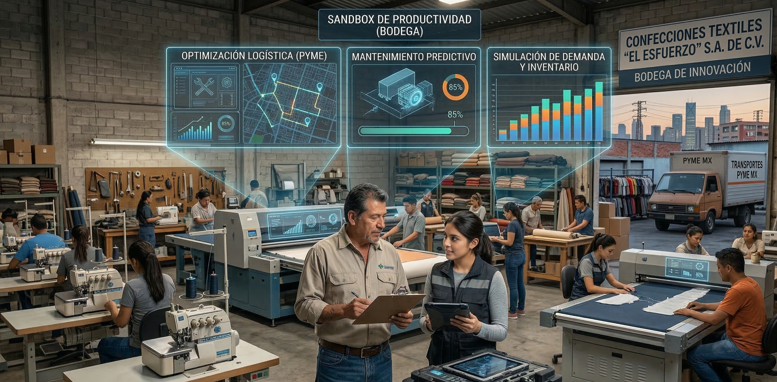
Imaginemos un Polo de Desarrollo donde el «costo de entrada» a la IA se diluya entre cientos de usuarios. Un sandbox industrial permitiría a las empresas probar:
-
Mantenimiento predictivo: Sensores compartidos que avisan antes de que una máquina crítica se detenga.
-
Optimización logística: Algoritmos que coordinan las rutas de salida de múltiples proveedores para reducir costos.
-
Simulación de demanda: Herramientas de análisis de datos para que la PYME no produzca a ciegas.
Un Puente entre dos Méxicos: Talento y Experiencia
Quizás el valor más disruptivo de estos sandboxes no sea el software, sino el capital humano.
Hoy tenemos una desconexión crítica. Por un lado, una generación de jóvenes brillantes que dominan Python, el análisis de datos y la IA, pero que a menudo carecen de contexto sobre cómo se mueve la mercancía en un puerto o cómo se gestiona una línea de montaje. Por otro lado, tenemos empresarios experimentados que conocen el mercado como la palma de su mano, pero que ven la IA como una «caja negra» inalcanzable.
El sandbox en el Polo de Bienestar funciona como el puente perfecto:
-
La PYME aporta el problema real: «Mi cuello de botella está en el inventario».
-
El joven talento aporta la solución técnica: «Podemos optimizarlo con este modelo de visión artificial».
No es un ejercicio académico; es innovación aplicada con piel en el juego. El joven aprende el negocio; el empresario adopta la tecnología; el país gana productividad.
De la Teoría a la Política Pública (PolicyTech)
Este enfoque nos permite transitar hacia lo que los expertos denominan PolicyTech: utilizar la experimentación y la tecnología para diseñar mejores políticas económicas. Al observar qué herramientas de IA funcionan realmente en el terreno, el gobierno y las instituciones pueden ajustar regulaciones y estímulos fiscales de manera precisa, no basada en supuestos, sino en datos de la operación real.
El Futuro no se Compra, se Cultiva
La inteligencia artificial no será una revolución en México porque existan mejores algoritmos en Silicon Valley. Será una revolución cuando una empresa familiar en un Polo de Bienestar pueda optimizar su producción sin poner en riesgo su patrimonio.
Los Polos de Desarrollo tienen el potencial de ser mucho más que centros de manufactura; pueden ser polos de aprendizaje económico. Si logramos que la IA deje de ser un concepto abstracto y se convierta en una herramienta tangible dentro de estos «sandboxes industriales», no solo estaremos construyendo fábricas. Estaremos cultivando el ecosistema humano que liderará la nueva era de la PYME mexicana.
______________________________________________________________________________________________
But if you step away from the auditoriums and walk onto the production floor of a small or medium sized company in the Bajío, the Isthmus, or even Monterrey, the narrative changes dramatically.
There, the intelligence that matters most is not artificial. It is emotional and financial intelligence. Reality is measured in cash flow, invoices paid in 90 days, and the daily effort to keep operations running. In that environment, asking an entrepreneur to invest in AI can sound, at best, like an expensive distraction.
The problem is not a lack of vision. The problem is that access to the technological frontier is deeply unequal. If Mexico truly wants to achieve the productivity leap promised by the new Development Poles, we need more than inspiring speeches. We need real productivity laboratories that are accessible to the real entrepreneur.
Today there are AI innovation hubs that charge membership fees of around one million pesos. For a company like FEMSA, that might make sense. But for most of the entrepreneurs who actually sustain Mexico’s economy and employment, that price point is simply out of reach. The obvious question becomes: what exists for them?
The Sandbox: Experiment Without Breaking the System
In the world of software development and fintech regulation, there is a powerful concept known as the sandbox. It is essentially a controlled testing environment where disruptive innovation can be tried in real conditions, but under supervision and with limited risk. It is a place where failure is not punished, but used to accelerate learning.
Countries like Singapore and the United Kingdom have used regulatory sandboxes to transform their financial systems. The logic behind it is simple but powerful. Instead of waiting for perfect regulation or for technology to become cheaper, you create a shared space where learning happens collectively.
Why not apply that same logic to manufacturing and services in Mexico’s small and medium sized businesses?
The Infrastructure is Already Emerging
Mexico is currently living through a historic moment of industrial reconfiguration. The national development strategy includes the creation of up to 100 strategic industrial parks known as Development Poles for Wellbeing.
These spaces should not be seen simply as concrete, industrial warehouses, and power connections.
They should be seen as shared data ecosystems.
Most SMEs cannot afford their own computing clusters, digital twins, or specialized machine learning models. But imagine if that infrastructure were shared inside each development hub.
The Shared AI Model
Imagine a Development Pole where the entry cost to artificial intelligence is distributed among hundreds of companies. An industrial sandbox could allow companies to experiment with tools such as:
- Predictive maintenance, where shared sensors alert companies before a critical machine fails.
- Logistics optimization, where algorithms coordinate outgoing shipments from multiple suppliers to reduce transportation costs.
- Demand simulation, where small manufacturers can analyze market data instead of producing blindly.
Suddenly, AI stops being a luxury technology and becomes a shared productivity tool.
A Bridge Between Two Mexicos: Talent and Experience
Perhaps the most disruptive value of these sandboxes is not the software, but the human capital they connect.
Mexico currently faces a quiet but important disconnect. On one side there is a generation of talented young people who understand Python, data analytics, and artificial intelligence, yet often lack exposure to how a supply chain actually works or how a production line is managed.
On the other side there are experienced entrepreneurs who understand markets, operations, and customers deeply, but who often see AI as a mysterious black box.
An innovation sandbox inside a Development Pole could become the perfect bridge.
- The SME brings the real problem.
«My bottleneck is inventory.» - The young technologist brings the technical solution.
«We can optimize that with a computer vision model.»
This is not an academic exercise. It is applied innovation with real economic consequences. Young professionals learn how businesses actually operate. Entrepreneurs discover practical technology tools. The country gains productivity.
From Theory to Public Policy
This model also opens the door to something increasingly discussed in economic circles: PolicyTech.
PolicyTech refers to using experimentation and technology to design better public policy. By observing what AI tools actually work on the factory floor or inside small companies, governments and institutions can design smarter incentives, regulations, and investment programs based on real operational data instead of assumptions.
The Future Is Not Bought. It Is Cultivated.
Artificial intelligence will not transform Mexico simply because better algorithms exist somewhere in Silicon Valley. It will transform Mexico when a family owned company inside a Development Pole can optimize its production without risking its financial survival.
Development Poles have the potential to become much more than manufacturing centers. They can become centers of economic learning.
If we manage to turn AI from an abstract concept into a practical tool inside these industrial sandboxes, Mexico will not only be building factories.
It will be cultivating the human ecosystem that will lead the next generation of Mexican small and medium sized businesses.