
English version below
Hay un riesgo que muchas PYMES en México no ven venir: automatizar procesos que ya estaban mal desde el principio. A eso algunos le llaman «automatización del caos». La idea suena tentadora la que nos venden en redes sociales todo los días, meter inteligencia artificial y esperar que todo mejore, pero si el proceso está roto, lo único que logras es cometer errores más rápido.
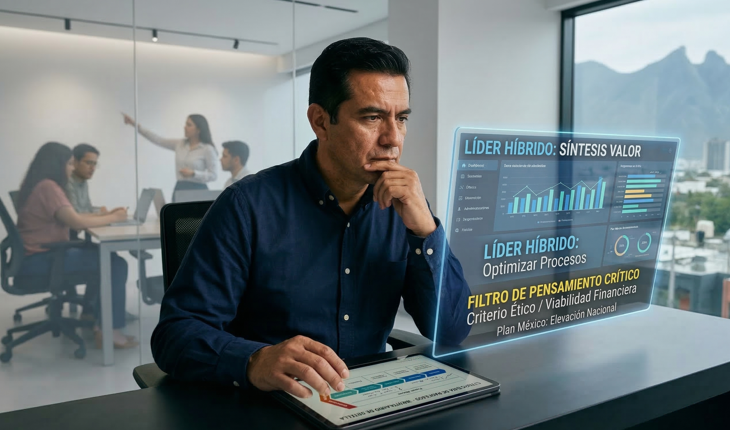
Por eso empieza a hablarse del líder híbrido. Un perfil que combina pensamiento crítico con uso inteligente de herramientas de IA. No es el que más prompts sabe escribir. Es el que entiende cuándo usar la tecnología y cuándo detenerse a pensar para liderea a su equipo o al proveedor a una verdadera solución que genera valor.
Primero entra el criterio.
La inteligencia artificial funciona con probabilidades. Analiza datos, patrones, texto, y a partir de eso sugiere cosas. Pero sugerir no es lo mismo que tener razón. El dueño o director de una PYME tiene que hacer de filtro. Preguntarse si lo que propone la IA realmente tiene sentido para su negocio. Si es viable en términos financieros. Si encaja con la cultura del equipo, a final de cuentas el es el experto en su negocio con a{os de experiencia que debemos exponenciar con la IA.
Ahí está el punto fino: la herramienta produce opciones, el humano decide.
De hecho, cada vez se ve más claro en el mercado laboral. Para 2026 muchas empresas ya no buscan solamente gente que sepa usar herramientas de IA. Buscan gente con criterio para decidir cuándo aplicarlas y cuándo no. La automatización ejecuta, sí. Pero la decisión sigue siendo humana.
Luego viene otro tema que suele pasarse por alto: los procesos.
La IA es muy buena resolviendo tareas concretas. Clasificar datos, redactar borradores, analizar información. Pero los problemas sistémicos, los que atraviesan toda la operación de un negocio, siguen siendo territorio humano y hay que adaptarlos para que Fluyan Humano y herramienta .
En una PYME eso se nota mucho. Antes de integrar inteligencia artificial conviene mapear cómo funciona realmente la empresa. Desde proveedores hasta ventas y cobranza. A veces el cuello de botella está en algo muy mundano: inventarios mal controlados, retrasos en facturación, seguimiento débil a clientes.
Si el líder no identifica ese punto crítico, la IA termina siendo un gasto más. No una inversión.
Cuando el proceso está claro, entonces sí. La tecnología puede acelerar lo que ya funciona.
Esto también conecta con algo más grande que está ocurriendo en México. El llamado Plan México busca aumentar el contenido nacional en sectores estratégicos hasta alrededor del 50%. Para que eso pase, las PYMES locales tienen que competir con estándares globales. Y eso implica procesos más eficientes, mejor información y decisiones más rápidas.
Ahí es donde la inteligencia artificial puede convertirse en ventaja real.
Falta todavía una pieza que a menudo se subestima: la comunicación.
Cuando se introduce IA en una empresa pequeña, lo primero que piensa el equipo es que vienen los recortes. Es natural. Si la dirección no explica bien el propósito, aparece la resistencia.
El líder híbrido hace algo distinto. Traduce la tecnología al lenguaje del equipo. Explica que la IA no está ahí para reemplazar personas, sino para aumentar su capacidad de trabajo. Automatizar tareas repetitivas. Liberar tiempo para decisiones más complejas.
También tiene otra habilidad poco mencionada: convertir datos técnicos en instrucciones claras. La IA puede arrojar análisis complejos, pero alguien tiene que decirle al equipo qué hacer con esa información el lunes a las nueve de la mañana.
Ese puente entre datos y acción es liderazgo.
Al final, el tema no es elegir entre humanos o inteligencia artificial. La combinación correcta suele ser otra: criterio humano arriba, automatización abajo.
Primero se entiende el problema. Luego se organiza el proceso. Y después, ahora sí, la tecnología entra a acelerar lo que ya estaba bien pensado.
Muchas PYMES todavía están descubriendo eso. Algunas lo harán tarde. Otras, las que entiendan esta lógica pronto, probablemente ganen una ventaja bastante seria en los próximos años.
English version
The Hybrid Leader: Critical Thinking and AI
There is a risk many small and medium-sized businesses in Mexico are starting to face, sometimes without realizing it: automating processes that were already inefficient. Some people call this «automating chaos.» The idea of introducing artificial intelligence into a company sounds attractive, but if the underlying process is broken, the only thing that improves is the speed at which mistakes happen.
That is why a new type of profile is becoming important inside growing companies: the hybrid leader. Someone who combines critical thinking with the practical use of AI tools. It is not the person who knows the most prompts or the newest platforms. It is the person who understands when technology actually helps and when it does not.
The first element is judgment.
Artificial intelligence works with probabilities. It analyzes patterns in data and generates suggestions based on what is statistically likely. But a suggestion is not the same as a truth. The leader of a small business still has to act as a filter. They need to question whether the insight produced by the AI is ethically sound, financially viable, or consistent with the company’s culture.
That distinction matters. The tool produces options. The human makes the decision.
In fact, this shift is already visible in the job market. By 2026 many organizations are prioritizing professionals who combine technological literacy with strong judgment. Knowing how to operate the tool is no longer enough. What matters is understanding why and when it should be used.
Then there is another issue that often gets overlooked: processes.
Artificial intelligence is excellent at handling defined tasks. It can classify information, draft content, analyze data or detect patterns faster than most teams. But systemic problems inside an organization still require human reasoning.
This becomes very clear in small and medium-sized businesses. Before integrating AI into operations, a leader needs to map how the company actually works. From suppliers to sales, from inventory management to collections. Many times the real bottleneck sits in something mundane: inconsistent inventory tracking, delays in invoicing, weak follow-up with customers.
If leadership cannot identify where that friction exists, AI simply becomes another expense instead of a productive investment.
Once the process is clear, technology can accelerate what already works.
This conversation also connects with broader economic changes happening in Mexico. The initiative often referred to as «Plan México» aims to increase national content in strategic industries to around fifty percent. For local businesses to compete under those conditions, their internal operations must become more efficient and data-driven.
Artificial intelligence can play a role in that transition, but only if the foundations are solid.
One final piece tends to be underestimated: communication.
When a company introduces AI tools, the first reaction from many employees is concern about job security. That reaction is understandable. If leadership fails to explain the purpose clearly, resistance appears quickly.
The hybrid leader handles this differently. They translate the technology into practical language for the team. Instead of presenting AI as a replacement for people, they frame it as an amplifier of human capability. The technology handles repetitive tasks, while people focus on decisions, relationships and problem solving.
There is another skill involved as well. AI systems can generate complex analyses and data outputs, but someone still needs to turn that information into clear instructions the team can act on the next morning.
That bridge between data and action is where leadership becomes visible.
The real question is not whether companies should choose humans or artificial intelligence. The more productive approach is combining both in the right order: human judgment first, automation second.
First understand the problem. Then structure the process. After that, technology can step in and accelerate what was already well designed.
Many small businesses are still figuring this out. Some will realize it too late. Others, the ones that learn to combine critical thinking with AI early on, may end up building a serious competitive advantage over the next few years.